“I’ve always been an anxious person, and I have a high-stress job as a police officer. I deal with trauma and conflict almost daily. I’ve seen the absolute worst of society, and I’ve done my best to support those in their moment of greatest need. I have arrested violent offenders, and on that same shift, spent hours talking someone down from ending their life. I’ve led complex investigations that would blow your mind, back in an era before AI was there to comb the data for you.
Then I would come home and make dinner. If I could, I’d pick the kids up from school and tackle homework with them—though when did primary school homework start resembling an engineering degree?
When my parents retired they went from decades of rigid routine to, all of a sudden, nothing. My big plan had always been to work hard, retire early and enjoy life. But this wasn’t what I saw in my parents who sacrificed so much to get to this point. Instead, my mum became severely unwell and was admitted to a psychiatric ward for months. Without a routine, she simply couldn’t cope. Sitting with herself in the quiet became unbearable once the distractions vanished. This scared me.
That was a few years ago now, but it was my wake-up call. I realized I urgently needed to work on my own mental health. I was twenty years away from my own inevitable breakdown, and I was speeding toward it like an unrestricted stretch of the Autobahn.
I wanted something that would exercise my mind in a completely different direction—something that didn’t involve balancing human rights, resource deficits, or public confidence. I wanted an antidote to the stress, a way to safeguard against the demons waiting for me in retirement. Having just finished a part-time degree in Leadership and Management, I figured I finally had the margin.
I’ve always loved music. I studied it in school, completed Grade 5 theory, and played both the French horn and percussion. Years ago, before kids and when disposable income was still a thing, I even bought a saxophone. I never learned to play it, but I kept it. The instrument that always fascinated me, though, was the piano. The idea of commanding an entire room and evoking raw emotion, completely on your own, felt extraordinary. How hard could it be?
It turns out you forget a lot in twenty years, especially when your musical diet has mostly been the odd Matchbox 20 album.
I began searching for a teacher who could take me from scratch to, ideally, the next Lang Lang. I reached out to a few and explained my situation: an “older” student keen to start. I was 40, and writing that felt bizarre. Forty isn’t ancient, but it gave me pause.
Cristina Santana replied quickly. Before agreeing to take me on, she set three questions:
1. *Why do you want to learn to play the piano?*
2. *What goals do you want to meet?*
3. *How are you going to work toward those goals?*
I just wanted to play. Why the interrogation?
At my first lesson, I spent the first fifteen minutes laying out the reality. My only goal was to heal and decompress. I didn’t care about formal grades or traditional metrics; I just needed an outlet. Cristina immediately understood. She drew on her own experience of the benefits the piano brings, while remaining realistic about the friction of starting as a time-poor adult. She accepted my need for a pure outlet, but gently suggested that down the line, grades might offer a healthy framework—not for vanity, but to anchor continuous improvement.
And so, we began.
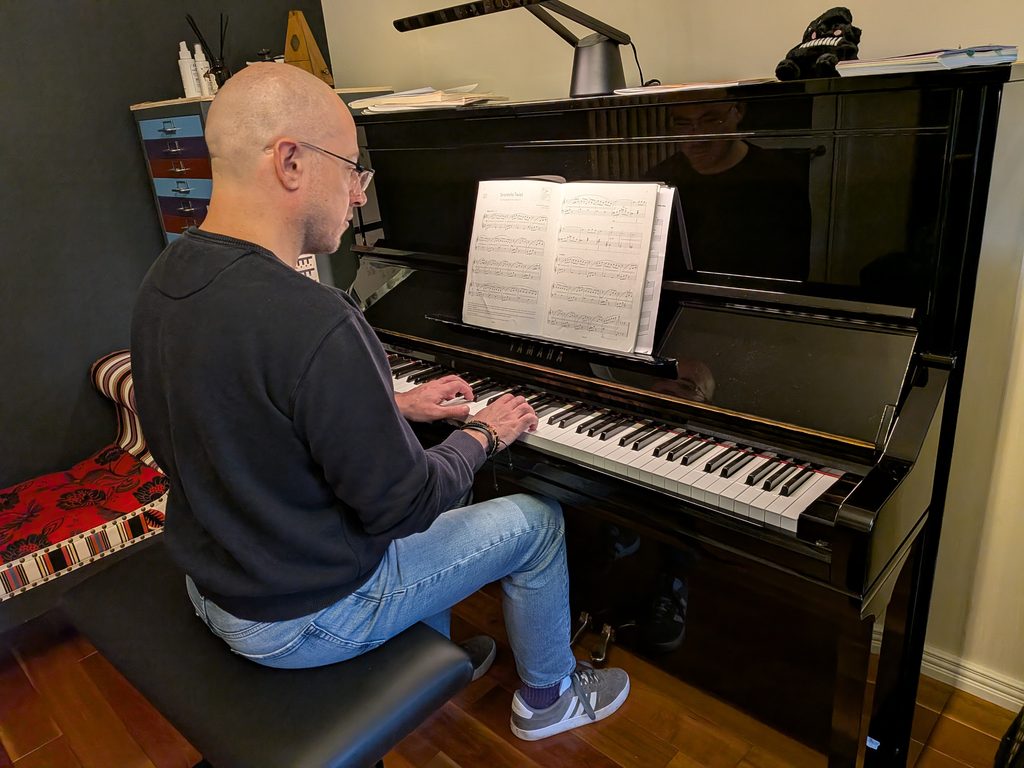
I quickly discovered that the piano was the exact mental release I needed. I’d sit down after a brutal shift and start practicing. Where many find only frustration in the monotony of stumbling over the same bar repeatedly, I found quiet.
My head stopped spinning. The tightness in my chest eased, and my heart rate settled. Playing became my personal therapy. I can sit for an hour striking notes that often sound dreadful, yet I’m never discouraged. Cristina teaches me how to deconstruct the music: breaking a piece down bar by bar, demanding three clean runs in a row before moving on, or even playing the composition backwards.
Her guidance carried me further than I ever anticipated. She eventually coaxed me onto a stage to play in front of an audience, and I passed my Grade 1. It turns out having concrete milestones does matter.
Through this, I’ve built an unexpected community. Cristina runs the Belfast Piano Group, bringing local adult players together. We meet every few months to share what we’ve been practicing, offer each other informal critique, and connect in a supportive, low-stakes setting. It has become a vital social anchor centred around something that has proven genuinely medicinal for me.
Learning the piano is hard. It is demanding, tedious at times, and frequently frustrating. But the return is immeasurable. It protects my mental health, dampens my anxiety, and pulls my mind completely clear of the demands of a high-stress career.
It gives me peace.” – Article by Patrick