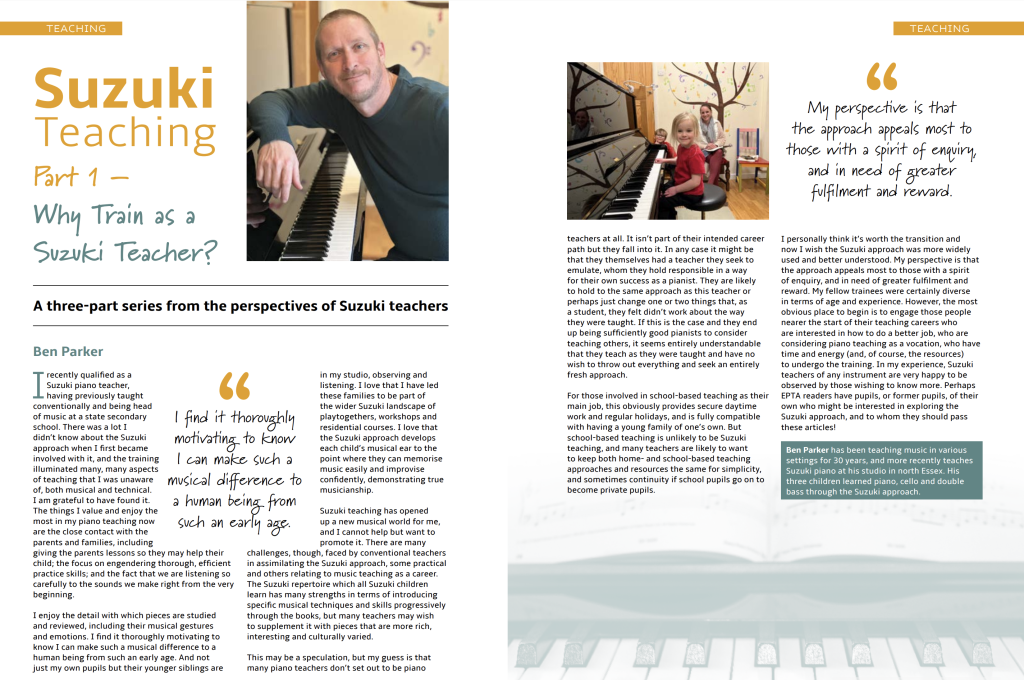
Suzuki Teaching – Ben Parker
Part 1 – Why Train as a Suzuki Teacher?
I recently qualified as a Suzuki piano teacher, having previously taught conventionally and been head of music at a state secondary school. There was a lot I didn’t know about the Suzuki approach when I first became involved with it, and the training illuminated many aspects of teaching that I had been unaware of, both musical and technical. I am grateful to have found it.
The things I value most in my piano teaching now are the close contact with parents and families, including giving parents lessons so they can support their child; the focus on developing thorough and efficient practice skills; and the emphasis on listening carefully to sound from the very beginning.
I enjoy the detail with which pieces are studied, including their musical gestures and emotions. I find it motivating to know I can make such a musical difference from an early stage. Not only my pupils, but also their younger siblings benefit from observing and listening.
I value how the Suzuki approach connects families through play-togethers, workshops, and courses. It develops musical ears so that children can memorise easily and improvise confidently, demonstrating real musicianship.
Suzuki teaching has opened a new musical world for me, and I cannot help but want to promote it. There are many challenges, though, faced by conventional teachers in assimilating the Suzuki approach, some practical and others relating to music teaching as a career. The Suzuki repertoire which all Suzuki children learn has many strengths in terms of introducing specific musical techniques and skills progressively through the books, but many teachers may wish to supplement it with pieces that are more rich, interesting and culturally varied.
This may be speculation, but my guess is that many piano teachers don’t set out to be piano teachers at all. It isn’t part of their intended career path but they fall into it. In many case it might be that they themselves had a teacher they seek to emulate, whom they hold responsible in a way for their own success as a pianist. They are likely to hold to the same approach as this teacher or perhaps just change one or two things that, as a student, they felt didn’t work about the way they were taught. If this is the case and they end up being sufficiently good pianists to consider teaching others, it seems entirely understandable that they teach as they were taught and have no wish to throw out everything and seek an entirely fresh approach.
For those involved in school-based teaching as their main job, this obviously provides secure daytime work and regular holidays, and is fully compatible with having a young family of one’s own. But school-based teaching is unlikely to be Suzuki teaching, and many teachers are likely to want to keep both home- and school-based teaching approaches and resources the same for simplicity, and sometimes continuity if school pupils go on to become private pupils.
I personally think it’s worth the transition and now I wish the Suzuki approach was more widely used and better understood. My perspective is that the approach appeals most to those with a spirit of enquiry, and in need of greater fulfilment and reward. My fellow trainees were certainly diverse in terms of age and experience. However, the most obvious place to begin is to engage those people nearer the start of their teaching careers who are interested in how to do a better job, who are considering piano teaching as a vocation, who have time and energy (and, of course, the resources) to undergo the training. In my experience, Suzuki teachers of any instrument are very happy to be observed by those wishing to know more. Perhaps EPTA readers have pupils, or former pupils, of their own who might be interested in exploring the Suzuki approach, and to whom they should pass these articles!
Ben Parker has been teaching music in various settings for 30 years, and more recently teaches Suzuki piano at his studio in north Essex. His three children learned piano, cello and double bass through the Suzuki approach.
Article written by Ben Parker. This article was featured in Piano Professional.